
Seventy years of the container. It’s time for FOX
The container is seventy years old this year. It changed how goods cross oceans. What it never changed is what happens to the box on land, when it is empty and nobody needs it where it stands. That is the problem FOX-storage is built for.
On 26 April 1956 a converted tanker, the Ideal-X, left Port Newark for Houston with 58 steel boxes on deck, loaded in under eight hours. Before that, a ship of that size took days to load, with every crate and barrel carried on and off by hand. Ten years later, on 3 May 1966, the Fairland arrived in Rotterdam with 226 containers and Europe started doing the same thing.
The idea was never about steel. It was about removing a step that cost money and added nothing.
The step that is still there
Inland, containers are used as storage. On building sites, at rental depots, at plants, at events, on infrastructure projects. They get delivered, they get used, and then they sit.
An empty container takes up exactly as much room as a full one. It takes a full truck to move, and a full parking spot to keep. So the industry works around it. You keep depots close to customers, because moving a box a long way costs as much empty as it does loaded. You keep spare units standing in each region, because you cannot get them there quickly enough otherwise. You plan around whether a truck can come back with something on it.
None of that is transport. It is work created by the shape of the box.
What changes when the box folds
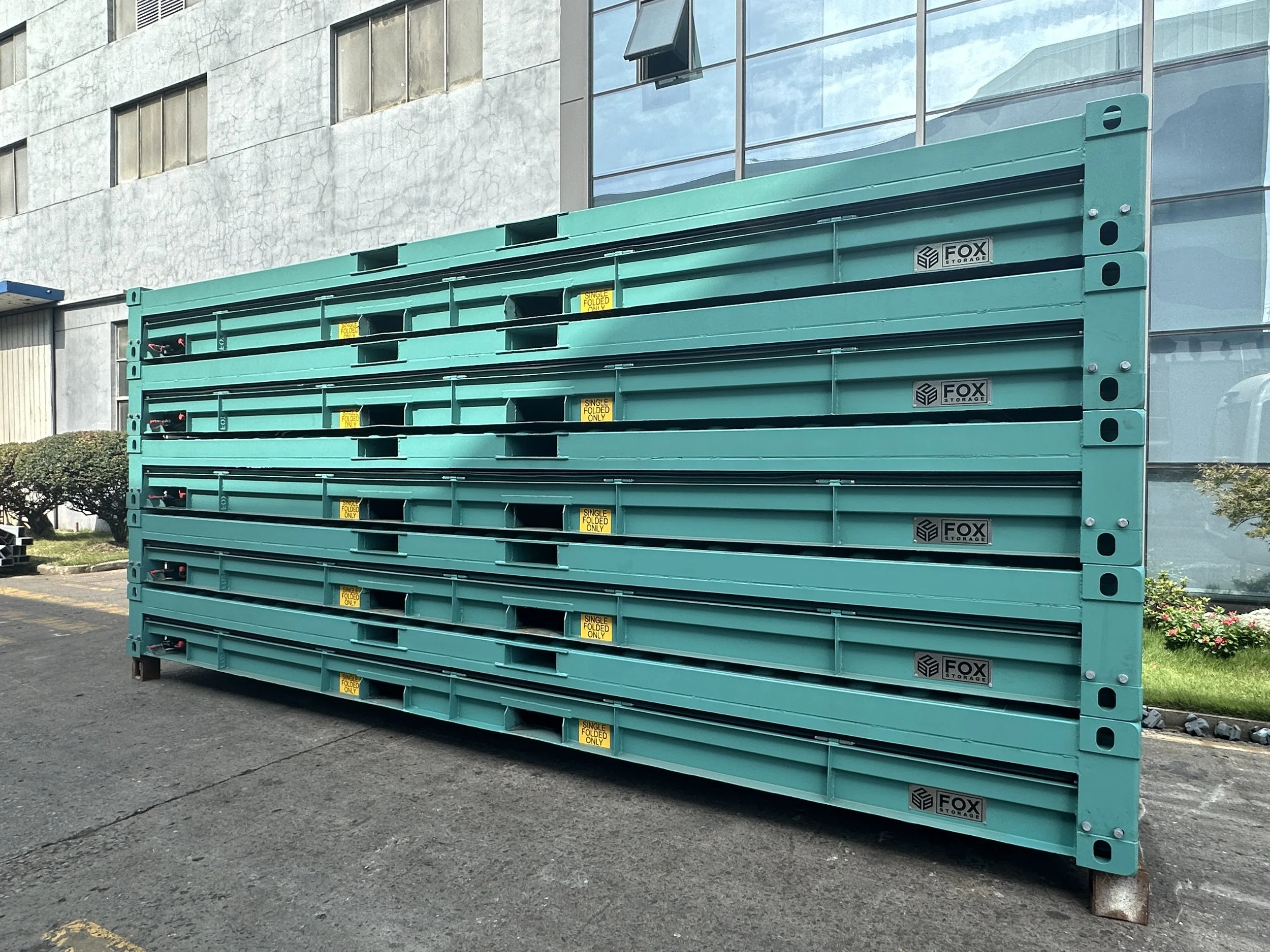
A FOX-storage container folds flat, five into the space of one. Deployed, it works like any other storage container. Folded, it stacks into a bundle a forklift can lift. Setting one up takes under five minutes.
That changes three practical things.
You need less ground. Folded units take up to 80 percent less space than the same units standing. A yard that was full of empties has room again, and the pressure to open another depot closer to the customer goes away. Fewer depots, less rent, less staff, less standing stock.
You need fewer trucks. Ten empty units go back on one truck instead of five. Four out of five return trips simply do not happen. That is fuel and driver hours you do not pay for, and four fewer trucks on the road. Less traffic, and the emissions drop by the same proportion, because a trip you never make produces nothing.
You need less planning. Most of the coordination in container rental exists to avoid moving air: matching return trips, chasing units, deciding whether it is cheaper to leave a box where it is or bring it home. When five units fit on one truck, the calculation stops being tight. You bring them back because it is cheap to bring them back. That is overhead that disappears from the office, not just from the road.
This is not theory
We already run this at scale in bulk logistics. In Alabama, a 250,000 tonne annual steel scrap loop has been running on a fleet of our foldable containers for over a year, with shipper and carrier sharing one cost model. Publicly documented by the Alabama Port Authority. A smoothly running operation.
Inland storage is the simpler case. Fewer parties, shorter chains, and the operator usually owns both ends of the flow, so whoever pays for the fold is also the one who collects the saving.
Seventy years is long enough
The container was adopted because the cost case became undeniable once the equipment was built around it. Folding is the same argument, one step further on. Not a replacement for the standard box, and not everywhere at once. It starts where someone controls their own fleet, counts their own costs, and is tired of paying to move and store empty air.