
From scrap to steel: When container design changes the economics of a supply chain
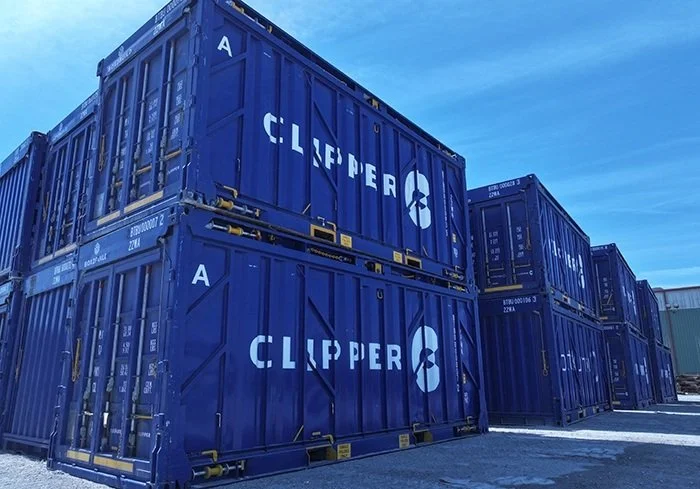
The Alabama Port Authority recently featured a collaboration between Box2Build, Clipper Bulk Shipping, Outokumpu, and Alabama Steel Terminal, highlighting how foldable container technology is helping make a circular steel supply chain commercially viable.
The real challenge wasn't transporting scrap steel
Moving scrap steel is technically demanding. It is heavy, abrasive and difficult to handle safely. But those challenges alone did not justify a new container.
The real challenge was economic.
The existing shipping route already connected Mexico and Alabama, transporting finished stainless steel for Outokumpu. The opportunity was to use the return leg to move stainless steel scrap back to Alabama for recycling, without sacrificing valuable transport capacity or creating unnecessary logistics costs.
Together, Box2Build, Clipper Bulk Shipping and Outokumpu developed a solution that achieved exactly that. Rather than redesigning the logistics network, the partners redesigned the transport equipment.
That changed the economics of the operation.
Engineering the flow
At Box2Build, we believe transport equipment should be designed around the operational challenge it solves.
For this project, that meant engineering a foldable container capable of handling demanding scrap steel operations while dramatically reducing the space required during empty returns. The solution integrates into existing port, vessel and inland transport operations without changing the underlying supply chain.
The result is not simply a better container.
It is a more efficient logistics system.
Beyond the steel industry
Although this project focuses on stainless steel, the underlying principle applies much more broadly.
Many industrial logistics networks operate fixed routes where equipment returns empty after every delivery. In those situations, empty repositioning becomes a structural cost rather than an operational exception.
Whenever transport capacity, storage space or repositioning costs become the limiting factor, equipment design deserves to be challenged.
Sometimes a standard container remains the right answer.
Sometimes a different design changes the economics completely.
Engineering before manufacturing
Box2Build develops transport equipment for specific operational challenges.
We start with the logistics flow, not with the container.
By working closely with partners such as Clipper Bulk Shipping and Outokumpu, we engineer solutions that improve the economics of industrial supply chains rather than simply replacing existing equipment.
The Alabama project demonstrates what can be achieved when operators, cargo owners and engineering specialists work together to solve the real problem: not moving cargo, but eliminating unnecessary empty logistics.
You can read the original article here:
https://alports.com/news/from-scrap-to-steel-how-smart-shipping-design-is-powering-a-circular-economy-in-alabama/