
From shipping containers to niche applications: What 15 Years of foldable container development taught us
Foldable containers are not a new idea. The concept has existed for decades. What has proven difficult is making them work in the real world, at scale, across the full chain of stakeholders that makes global container logistics run.
We have been in this field since the beginning. That experience has shaped how we build, who we work with, and where we choose to operate today.
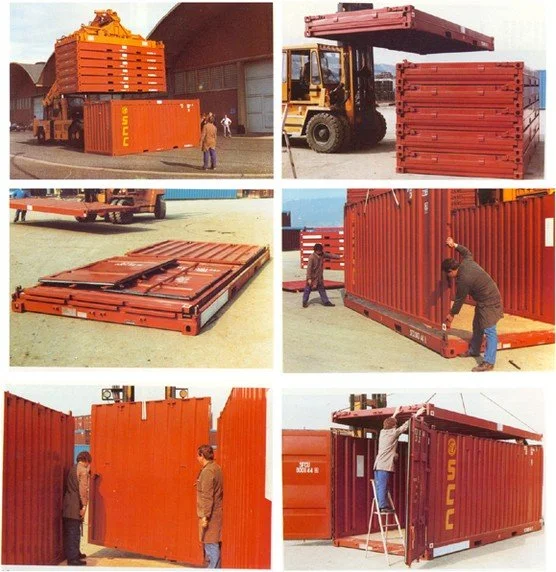
The six in one container
One of the first assembled containers in the world.
Where it started for us: The 40HC foldable shipping container
Around 2008, our team set out to build what did not yet exist: a fully certified, foldable 40HC shipping container. Not a prototype. Not a concept. A container that met ISO standards, could be stacked, handled with standard equipment, and shipped in exactly the same flows as a standard box.
We designed and engineered it from scratch, working with Asian factories that had deep experience in container manufacturing. Getting the design right was the first challenge. Steel construction at this scale is unforgiving. Every millimeter of tolerancing matters when you are producing something that needs to fold reliably thousands of times over a twenty-year service life.
We got it certified. We got it built. That alone put us in a category of one.
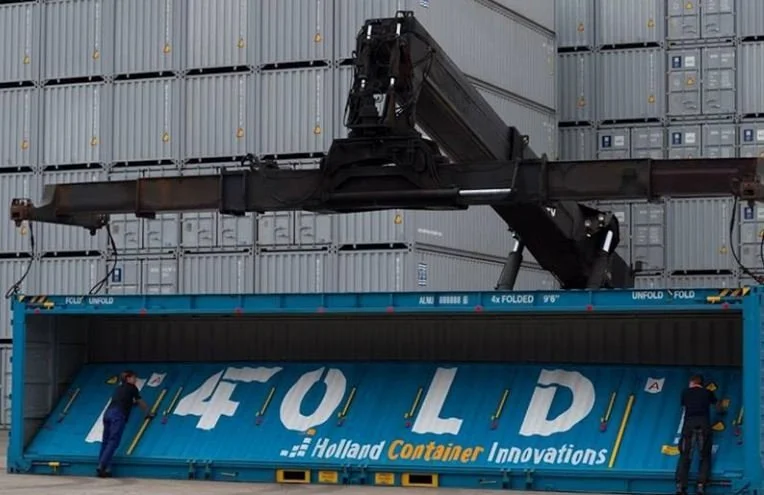
Back in 2013
Arthur and Joris folding the first 40HC fully ISO certified foldable shipping container in the world.
The operational challenge
Building the container was the technical milestone. Making it fit into existing transport flows was a different problem entirely.
Container logistics is a system built around standard dimensions, standard handling equipment, and standard processes. Introducing a product that behaves differently, even slightly, creates friction across every touchpoint: terminals, depots, carriers, shippers, freight forwarders. Everyone needs to adjust something.
We worked through this in operations across multiple continents. Every deployment taught us something. The folding process needed to fit within existing handling cycles. The stacking configurations needed to work within existing yard layouts. The repair and maintenance protocols needed to fit within what operators actually had available.
By the time we had done this across enough corridors to call it proven, we had a genuinely operational product. But the hardest part was still ahead.
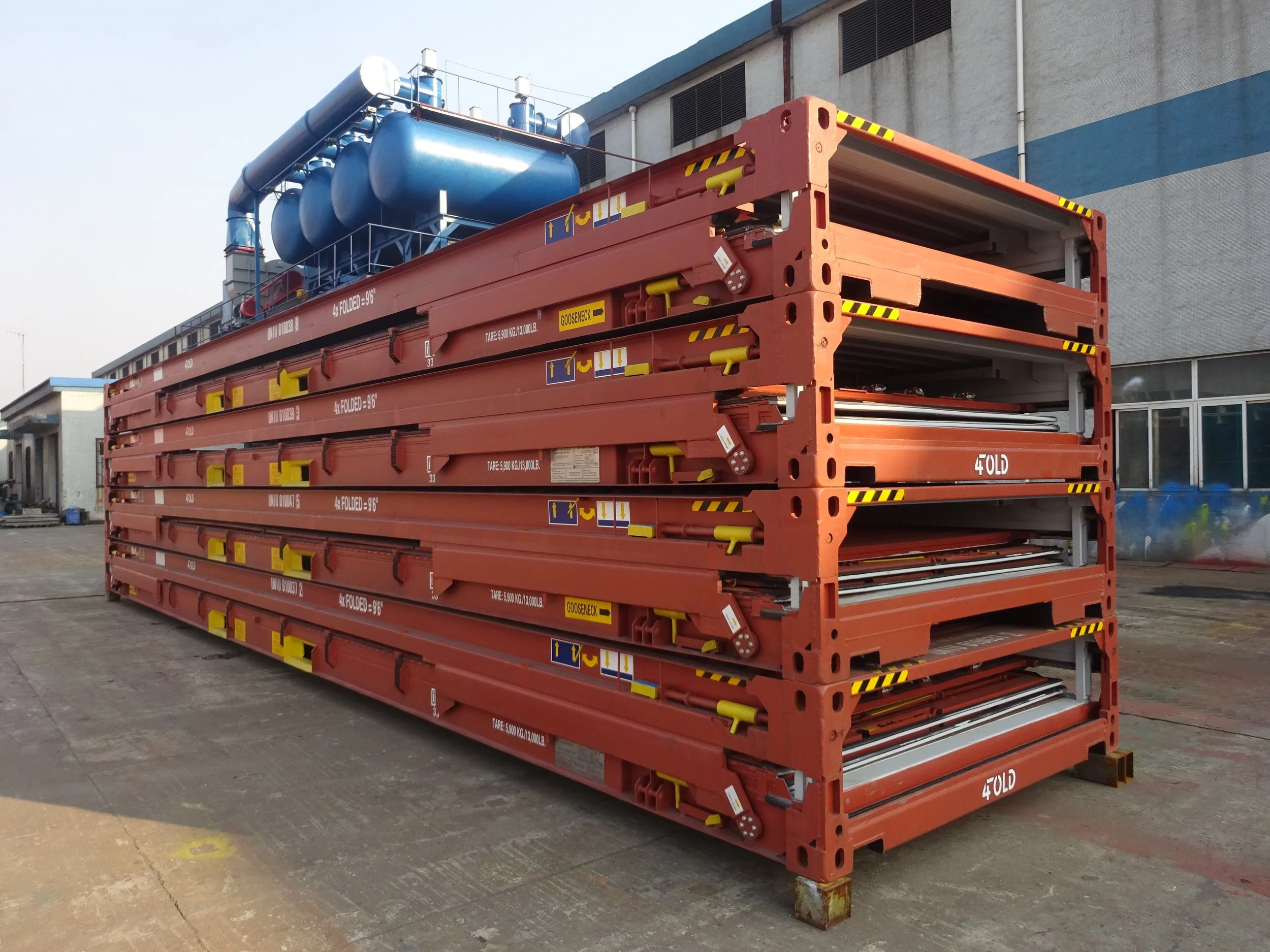
The bundle
A bundle mechanically handles mostly the same, but different logistic management is needed.
The commercial challenge: shared savings, multiple stakeholders
Foldable containers save money on empty transport. That is their core value. But in shipping, the cost of an empty move is rarely paid by a single party, and the saving is rarely captured by a single party either.
The shipper pays for some of it. The carrier pays for some of it. The depot operator is involved. The leasing company has a position. The freight forwarder may be in the chain. Getting all of these parties to agree on how to share the efficiency gain, and who bears the additional cost of a slightly more complex asset, is a commercial and organisational challenge that has nothing to do with engineering.
We worked on this. We built models. We structured proposals. We sat in rooms with multiple parties trying to align interests that did not naturally align.
What we learned: the shipping container industry is the backbone of global trade. It is also one of the most conservative industries in the world. Changes move slowly by design. The system is optimised for reliability, not for innovation. Introducing a new asset class into that system, at the scale needed to make commercial sense, is not a project. It is a decade-long campaign, and even then it is not guaranteed.
We chose not to stay in that campaign.
The shift: Innovation in small steps, with the right partners
The experience in shipping taught us something fundamental: innovation in logistics does not happen through ambition alone. It happens when the right product meets the right partners at the right point in the chain, and when the commercial logic is simple enough that multiple parties can agree quickly.
With Box2Build, we moved toward applications where those conditions could be met: foldable land containers for storage and inland logistics, foldable event decks, and foldable bulk containers for specific industrial flows.
In the bulk segment, this produced a result we are proud of. A 250,000-tonne steel scrap loop, serviced by a fleet of our foldable bulk containers. Both shipper and carrier agreed on the cost model. Both shared in the CO2 reduction. A joint project, built on trust between parties who understood each other's operations, produced a commercially sound outcome for everyone involved.
That is what success looks like in this industry. Not a press release. A running operation.
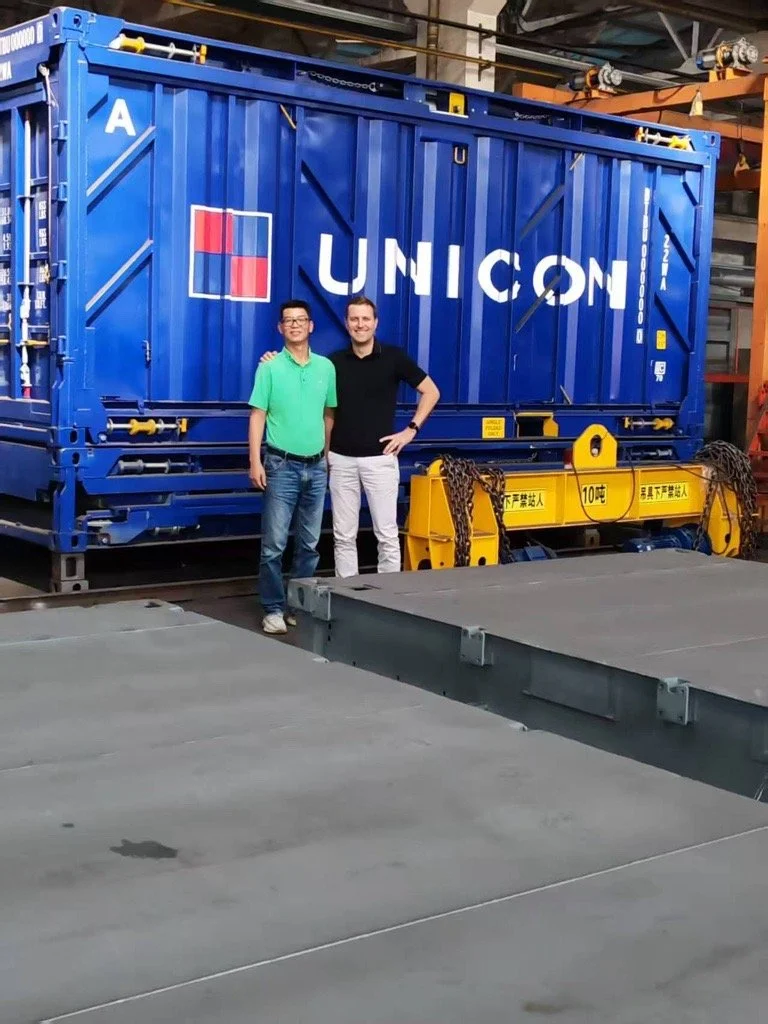
Factory partnership
It’s the people behind the businesses that make the success.
The storage container: designed for the conditions it actually operates In
The FOX-storage container came from the same logic. Land and storage applications have different requirements than maritime shipping. Fewer certification layers. Different handling equipment. Different cycle times. Different stakeholder structures.
So we designed specifically for those conditions. Simpler construction. Lighter. More cost-effective to produce. Still built according to maritime engineering principles, because that is what gives a container long service life and reliable performance. But not over-engineered for a sea environment it will never operate in.
The result is a container that folds to one-fifth of its deployed footprint, handles with a standard forklift, and can be set up in under five minutes. The ROI for operators is faster and more direct than anything we achieved in the shipping market. Fewer parties in the chain means fewer alignment problems. The decision cycle is shorter. The commercial model is cleaner.
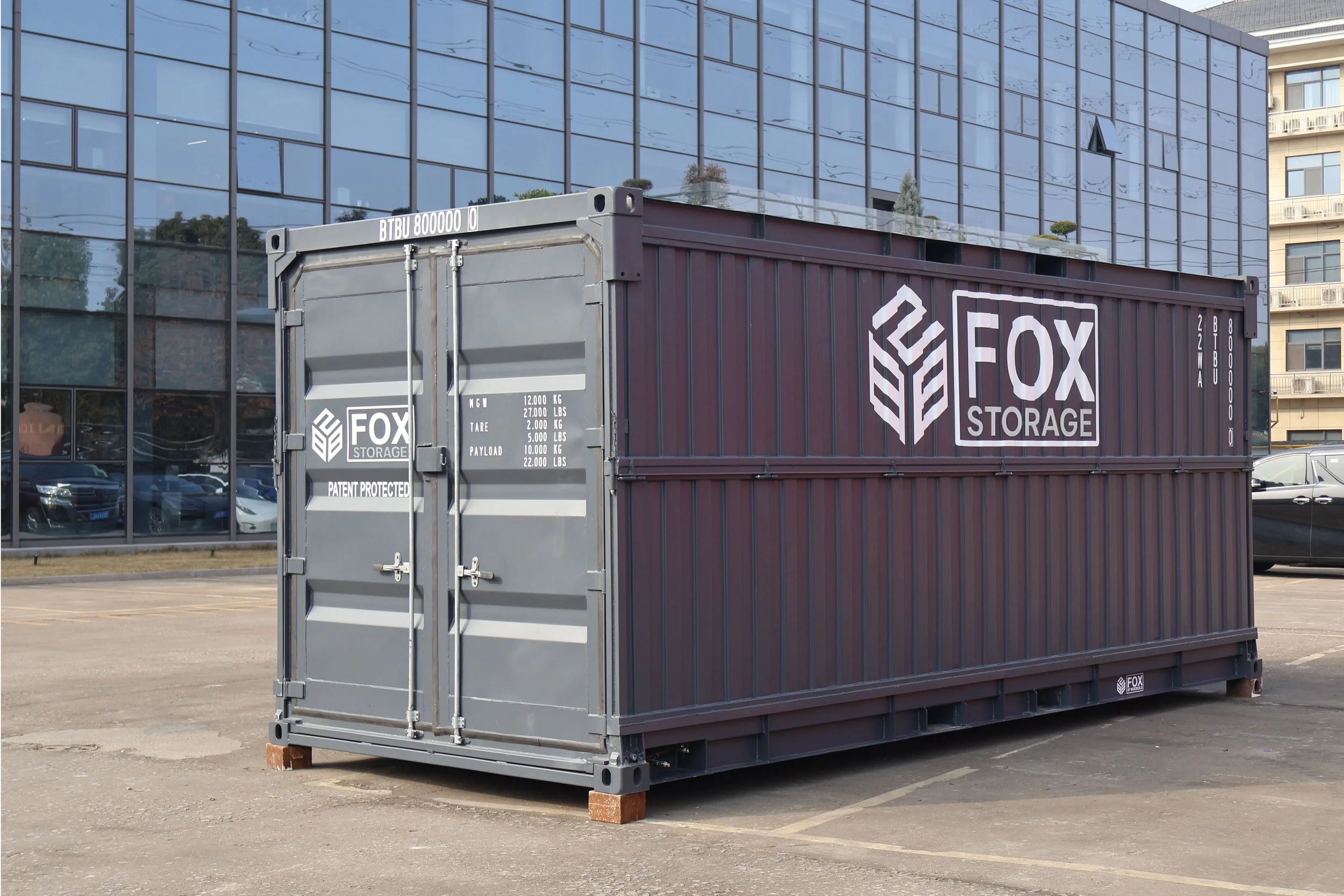
The 20ft foldable (5:1) FOX storage container
What we see in the market now
There are companies today working to do in shipping what we did fifteen years ago. We understand that ambition. We held it ourselves.
What we know from experience is that cracking the shipping container market requires more than a good design and a certification. It requires manufacturing relationships built over decades. It requires deep knowledge of how containers actually move through global flows. It requires commercial structures that can work across parties with competing interests. And it requires time, in a market that measures change in years, not months.
We are not saying it cannot be done. We are saying it takes all of those things together.
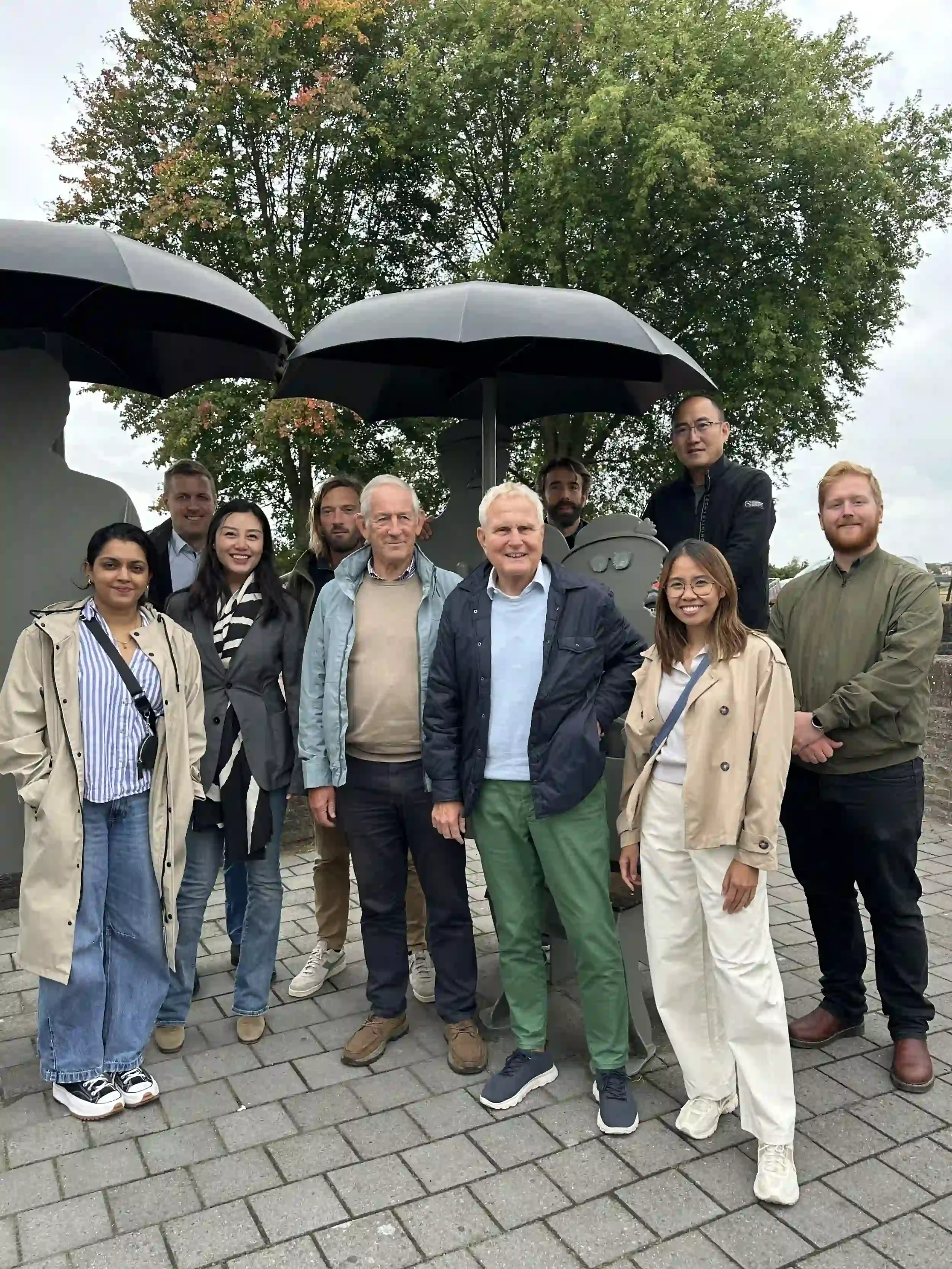
Box2Build team
The international team, with a unique set of experience
Why this matters for what we do today
Box2Build carries something that most companies in this space do not have: the full stack of experience. Engineers who have been designing foldable containers since 2008. Relationships with Asian manufacturing partners built over more than a decade. Business people who have been operating in international trade for fifty years.
That combination, applied to markets where the conditions for adoption actually exist, is what puts us where we are: the only company in the world that has moved from trial units to hundreds of deployed foldable containers in commercial operation.
The lesson of fifteen years is simple. Find the place where the product fits the operation, find the partners who can see the value, and build something that works for all of them. Everything else follows from that.